It’s Review Time once more! I wrote one of these articles toward the end of last year about Kamen Rider Gavv, Buddyfight, and Fate/Stay Night. Now the time has come to clear some things off the Now Playing page once again. Today, we’ll be talking about the Type-Moon Visual Novel “Tsukihime”, the Sunrise anime “Mobile Suit Gundam: The Witch From Mercury”, and the Namco-Bandai video game “Digimon Story: Time Stranger”.
Tsukihime
Tsukihime is the precursor to a Visual Novel I wrote about in a previous article, Fate/Stay Night. Produced by Type-Moon, written by Kinoko Nasu and illustrated by Takashi Takeuchi, Tsukihime is operating on a way smaller budget. It’s got a kind of intimate feel to it. You can TELL this was made by a couple of friends in a basement leading up to Comiket. It might help that I played the game using a fan-made Nintendo DS Port… Really made it feel like an artifact.
Much like Fate/Stay Night, this game has a number of routes in which our protagonist, Shiki, falls in love with a different girl. Rather than being a game where you pick a girl you like, you play through each route in order and progressively learn more about the world and Shiki’s relationship to it. These routes eventually culminate in a pretty strong thesis about being alive and coping with major mistakes. Tsukihime is split into two parts: 2 Near Side routes and 3 Far Side routes.
The Near Side has to be read before the Far Side and focuses on the various supernatural occurrences that haunt the town. It’s probably the portion of the game with the largest scale, being about catching a Serial Killer Vampire before he sucks the whole town dry (of blood, you animal). Arcueid’s route is the first one in the recommended play order and it’s an EXCELLENT introduction to what Tsukihime is, both the highs and the lows. It grabs you real fast with a scary vibe and some really lovely prose. You can find a recommended route order and guide courtesy of Xerblade.
The Far Side routes are more introspective. The stakes are just as high, but the scale is smaller. Rather than being about conflicts with Vampires From The Moon or what have you, Tsukihime’s Far Side Routes zero in on Shiki’s complex relationship to his family and is where the game TRULY gets good imo. As much as I love Arcueid and am frustrated with her absence, the Far Side routes are a really good metaphorical exploration of Living Your Life With Obsessive Compulsive Disorder. I don’t mean, “Oh Shiki looooves cleaning”, I mean, “Shiki is constantly worried that he is a literal actual serial killer because of absurd and disturbing dreams he has throughout the story.” I’ve really enjoyed these stories from Nasu that are fantastical takes on… living with mental illness, mostly?
I do have a number of critiques of Tsukihime. While it might be one of my favorite visual novels ever, it does fall into the major eroge pitfall. It tries to have its cake and eat it too when it comes to depictions of sexual violence. The game gets a little better about this in the Far Side, but that doesn’t mean we didn’t have a sexy CG dedicated to Arcueid being raped, with the CHOICE to see a second one in exchange for a Bad End. I think it manages to stick the landing when it comes to talking about the effects sexual assault can have on a victim’s psyche, but I do absolutely have to WARN people that the handling is kind of rough at times.
While being an indie eroge comes with some issues, Tsukihime DOES get to benefit from being completely uncensored and unabashedly itself. This visual novel feels unburdened in a way that few works produced by a company can. There’s all kinds of things in Tsukihime that I just cannot imagine being in a retail release of a game these days. It’s part of what makes me a little worried about reading Tsukihime Remake. Thankfully, I’ve heard a lot of Good Things about it, but I’ll save them for when it’s my turn to check it out.
Mobile Suit Gundam: The Witch From Mercury
I have to be totally honest with you, I don’t know if I want to write a full-on review about G-Witch. This show has been talked to DEATH by people far more invested than me. I am absolutely late to the party on watching it and I know that what I have to say about it isn’t NEW. Then again, Tsukihime is 20 years old and I wrote a page on that. I might as well talk a LITTLE about G-Witch.
The Witch From Mercury is a show that is about many things. Some might even say it is about too many things. It is a political drama, as Gundam often is. It is a romance. It’s also about parental abuse and cycles of violence. That last thing is why the show was recommended to me. I was talking about how fucked up it is that your parents can both abuse and nurture you simultaneously, only to be told there’s Quite A Bit Of That in G-Witch. It might be the thing G-Witch was the most successfully “about”, right after Cool Robot Fights. Almost every parent in this show is At Least A Little Evil. Many of them are not without reason, but those reasons are often twisted. Delling may have wanted an end to war, but he still made a little game out of finding a Big Strong Husband to “protect” his daughter, whether she liked it or not. Prospera… was Prospera. There’s definitely already a paper written SOMEWHERE about Prospera, right? Everything she does, she does for the good of her daughter. No, the other one. I can’t say the other parents in G-Witch left much of an impression on me but, Prospera is a STRONG showing for Girls With Complicated Relationships To Their Mothers. I might even consider Prospera and Suletta’s relationship more complex than Suletta and Miorinne. Might. Not sure about that, but it’s close.
During the writing of this review, I was informed that the staff expected an entire third cours of the show and were informed halfway through that they had about 6 episodes to finish what they were doing. This does genuinely explain many of the things I was going to take issue with. Namely, I feel like the final episodes of the show move too quickly to wrap everything up in a neat little bow. The second Quiet Zero is dealt with, Miorinne stops a space laser from being fired by saying, “I’m giving away free money!” and then everyone lives happily ever after. I was really interested in more of the fallout of the Earth/Space divide following this but, there’s not too much time to get into it and digest it.
I’ve heard the Earthian/Spacian civil war be called set dressing for the real show to happen. To concede that is to concede that several major scenes in G-Witch are spinning their wheels. If we are going to spend sizable amounts of time with Earthian resistance members, including the climax of the first cours and the majority of the second cours, I am going to invest myself in their struggle. Of course I’m going to find it strange how little this portion of the show intersects with our main cast. Despite being named Earth House and having family that is affected by Spacian policies back home, our main cast is not very politically active. The bridge between the “main” plot and the “Earth” plot is Nika, who I recently learned is in every episode of the show despite not making a particularly strong impression on me. The Earth House cast is full of really strong personalities, so it’s weird how the one that is actually a mover and shaker of the story is so… subdued. There being one solitary character that is involved in both of the story’s conflicts, and that character being resident wallflower Nika, makes them feel a little disjointed from one another. It would have been an improvement if Earth House cared a little bit more about what’s going on back home. Having one really impassioned person could work, but Nika spends the majority of the second cours isolated from the main cast in a room with two other people who also don’t really talk to anybody else.
With all our negativity out of the way, it is now time to heap some praise upon Mobile Suit Gundam: The Witch From Mercury. Do I even need to tell you that this show LOOKS gorgeous? Yes, the mobile suits are pretty to watch but even scenes with human characters look outstanding. I really love the way hair moves in particular.
G-Witch’s cast is probably the strongest part of it, even if I think it could be like 10 characters smaller and be fine. I love Suletta, she reminds me of myself in a lot of ways. She’s not exactly dripping with confidence and machismo, but she’s good at what she does regardless. She’s got a big heart and sometimes people (Prospera) take advantage of that. Miorinne is a classic “Teen dealt a bad hand who is lashing out”. She has trouble connecting with others because Daddy Decided Her Connections For Her growing up, but she genuinely honestly wants to take a stand against war profiteering. And Sophie? Oh my GOODNESS, Sophie! I love Sophie so much. A mercenary who only has one thing on her mind: Getting closer to an idol she’ll never be able to reach so that she can tear the target of her affection’s wings off like a little bug. Every moment she was on the screen was a DELIGHT.
Messy family relationships were the thing best explored by this show. The scene toward the end of the first cours where Prospera uses, “Running away gains one, but pushing forward gains two.” to tell Suletta that killing is okay sent shivers down my spine. Prospera is terrible to Suletta and Suletta doesn’t know any better, so she just lets it keep going. At the end of the day, there’s someone else that connects them, someone they love very dearly. Gundam Aeiral. Ericht Samaya. Eri! Despite getting very little time to speak her own mind, Eri is the locus around which the Mercury family revolves. Every single scene Prospera is in we watch her weigh how much she’s come to care about Suletta against how badly she wants Eri back. To Prospera, Eri is her “true” daughter. Suletta is nothing but an imitation of what she’s lost and yet, that imitation is so life-like. Suletta, on the other hand, DOES love her big sister dearly. She’s blind to the ways in which their mother puts her second, but even if she knew about them she’d have a hard time resenting Eri for it. Eri is the center of attention, but she is lacking in agency due to the actions of her mother. A Mobile Suit is not something that moves and thinks for itself. It is a tool to be used by people. Aerial is a mechanism for Prospera’s motherly love to suffocate and contain Eri. Suletta is the only person who can hear her. There is no one else that acknowledges she is or ever was alive. Despite the hell she’s gone through as a Ghost in the Machine, she still does whatever she can to protect Suletta because that’s what a big sister is supposed to do. The one time Eri DOES exercise her own agency as Aerial, it’s an attempt to keep Suletta’s hands free of blood, knowing full well she herself has to do whatever their mother says going forward. Suletta is a Second Child unloved by her mother, Eri is an Eldest Daughter that is “the favorite” but is still treated more like a toy than a human girl. Prospera isn’t really looking out for either of them, so they cling to each other. They take whatever actions they can to protect one another, even if they’re meager.
G-Witch is not a perfect show by a long shot, but I do believe these writers and animators were doing the best with what they had. What they ended up coming out with was something beautiful that was absolutely worth my time watching it. It has its flaws, but there’s plenty good to dissect and rotate in your mind.
Digimon Story: Time Stranger
Congratulations to Digimon Story: Time Stranger for being the first non-Visual Novel video game I wrote a review for on this site. It’s a rather lengthy RPG and the latest installment in the Digimon Story series at time of writing. I waited a long time for this game to come out. Was it worth it? Absolutely!
There is so much to gush about in this game! Firstly, the gameplay systems have been refined in some interesting ways since Cyber Sleuth/Hackers’ Memory. Every Digimon you own gains experience from battles, not just ones in your party. The DigiFarm is much more straightforward now, allowing you to train individual Digimon in specific stats. You even get a message when training is finished that allows you to repeat the same training regimen without going all the way back to the farm. Battles are now overworld encounters. Digimon have personalities that shift based on how you talk with them and they affect evolution and stats. There’s some pretty reasonable gates in place that prevent you from grinding for Mega Level Digimon right away so you get plenty of time throughout the game to appreciate your Rookie, Champion, and Ultimate Digimon. I’m going to stop before I just sound like patch notes, but there’s a LOT here that’s different. Most of it is streamlining clunky systems from previous Digimon Story games, the rest is adding brand new things on top that are flavorful or just make for Good Gameplay.
The difficulty scaling of Time Stranger is a lot more interesting and finely tuned than previous Digimon Story games. On Normal Mode, I very rarely felt that I was simply too underpowered for a fight. Just by exploring my options, retooling my team, and using items I could make it through most fights. There were two difficulties added SPECIFICALLY for New Game+: Mega, which scales all the fights in the game to the end game, meaning you are expected to use your full party of Mega Digimon to take down Koromons in the sewers, very funny stuff; And Mega+, which is Mega Difficulty… plus you can’t use items or run from battles. Once you’re in a fight, you have to see it through. I’ve yet to do a full Mega Difficulty playthrough, but the portions of the game I did play on it were pretty engaging.
The STORY of Time Stranger is just as worth your time as its gameplay. You take on the role of an Agent for a secret organization known as ADAMAS, correcting Space-Time anomalies caused by Digimon. An encounter with an informant leads to you being shunted 8 years into the past where you’re tasked with settling a war between two factions of Digimon before their conflict spills over into the human world and causes an apocalyptic event known only as the Shinjuku Inferno. All the while, you’re tasked with watching over Inori Misono, the teenaged informant from the first act, and her Digimon partner Aegiomon, a satyr who reminds Inori of the little brother she’d lost almost a decade prior. Watching their familial bond grow over the course of the game is a treat. Like G-Witch, Time Stranger is at least a third about family drama. It’s a lot less harsh than G-Witch in that regard, but I enjoy Inori and Aegiomon’s dynamic. It grounds the emotions of the story in something familiar to me. Also, this game DOES have a Final Fantasy VI-style “World of Ruin” arc where we revisit a bunch of old areas that have changed for one reason or another. I always love those. My compliments to the chef.
Time Stranger also has a DLC pass that is… divisive. $30 for 3 bonus episodes, each coming with an additional 5 playable Mega Digimon. While I haven’t finished all 3 DLC episodes at the time of writing, I do think these little vignettes that look in on parallel versions of the game’s main story are a fun way to spend an afternoon with characters I came to love during the main game. There’s been a lot of discussion about the choices for additional digimon. Many think there should have been entire new Digivolution lines added in, but pairing it down to Mega Digimon means we can include more different choices while also implementing digimon that could be used IN the DLC and on higher difficulties of the game. If a DLC pack chose to add Gammamon rather than say, the various Omnimon alternate forms added in the first pack, they would spend 3 of their 5 slots (Gammamon, BetelGammamon, Cannoweissmon) on Digimon that players would be unlikely to be able to spend time with. By making sure that all added Digimon are viable options for late-game content, they ensure players actually get to PLAY with their new toys. There’s been a Time Stranger Expansion Pack announced for some time next year. I can only hope it features a new story that asks the player to raise new Digimon. That way, there’s development time AND reason to include fan favorite Digivolution lines that were created after the game’s roster was set in stone.
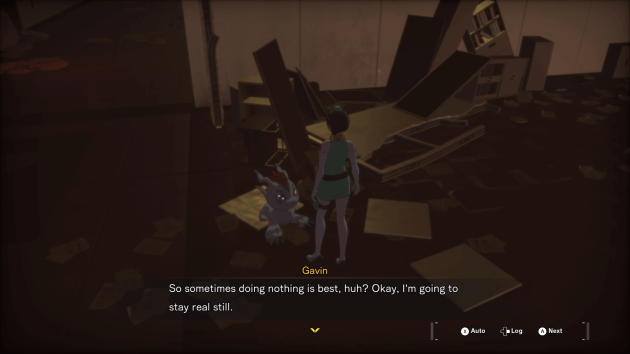
Digimon Story: Time Stranger was a breath of fresh air. It blended modern rpg quality of life features with a series I loved, rough edges and all, to create a new, polished experience that I’m certain I’ll be revisiting in the future. It might have been my game of the year if Hundred Line wasn’t released the same year. Also Gavin is there. Look at Gavin.